If you’re still optimizing for individual keywords while your competitors build topical authority, you’re losing qualified traffic to AI Overviews, ChatGPT, and Google’s Knowledge Graph. Here’s what’s actually working in 2026.
Semantic SEO is optimizing your content around topics, user intent, and the relationships between entities, not just keywords. At SevenSEO, we’ve seen companies double their pipeline by shifting from keyword-stuffing to semantic content strategies that rank in both traditional search and AI-powered platforms.
The shift is real: Google’s AI Overviews now appear for 21 % of keywords in US search results, and they prioritize content that demonstrates topical authority and contextual relevance. If your content doesn’t understand entities, intent, and semantic relationships, you’re invisible where it matters most.
Key Takeaways
- Semantic SEO focuses on topics, not keywords: Modern search engines analyze meaning, context, and relationships between entities to determine relevance.
- AI search rewards topical authority: Platforms like ChatGPT, Gemini, and Perplexity prioritize content that comprehensively covers subjects with clear entity relationships.
- Entity optimization matters: Google’s Knowledge Graph connects people, places, organizations, and concepts, your content needs to map to these relationships.
- User intent drives conversions: Semantic content that matches search intent (informational, commercial, transactional) converts 3-5x better than keyword-focused pages.
- Structured data amplifies visibility: Schema markup helps both traditional search engines and AI platforms understand and cite your content.
What Is Semantic SEO? (And Why Startups Need It)
Traditional SEO meant picking a keyword, hitting a target density, and hoping for rankings. Semantic SEO means understanding what users actually want, how concepts relate to each other, and building content that serves both humans and AI systems.
Here’s the difference: A keyword-focused article targets “best project management software.” A semantic SEO article covers project management workflows, team collaboration challenges, integration needs, pricing structures, and use cases, while naturally incorporating dozens of related entities and long-tail queries.
Google doesn’t just read words anymore. It analyzes phrases, combinations, and topical contexts using mathematical models that identify relationships between entities through embeddings. Think of embeddings as a way for AI to measure how closely related different concepts are, words like “king” and “queen” sit near each other in this virtual space because they’re semantically connected.
How Google Understands Meaning: Entities and Embeddings
Since search engines aren’t human, Google developed a mathematical approach to “explain the world” through entities. Entities are distinct objects or ideas, people, places, organizations, concepts that hold meaning. When you mention “Apple,” Google uses context and surrounding entities to determine whether you mean the fruit or the company.
This works through embeddings, which transform words into numerical vectors. Similar words appear closer together in vector space. Instead of matching exact keywords, Google compares these vector representations to find the closest semantic match to a user’s query.
Google organizes all of this using the Knowledge Graph, a vast network of interconnected entities and their relationships. When you build semantic SEO properly, your content’s embedding aligns closely with user queries in vector space, making it relevant for dozens or hundreds of related searches.
The AI and NLP Revolution
Every major Google algorithm update since 2012 has pushed toward semantic understanding:
- Knowledge Graph (2012): Organized information into a sophisticated knowledge base connecting entities and concepts.
- Hummingbird (2013): Enabled Google to understand entire query meaning and context, not just individual words.
- RankBrain (2015): Introduced machine learning to better interpret search intent and deliver relevant results.
- BERT (2019): Revolutionized conversational search by emphasizing previously “unimportant” words like conjunctions and their placement in queries.
- AI Overviews (2024): Integrated generative AI directly into search results, creating interactive snippets that respond to queries with verified answers and source links.
Generative Engine Optimization is becoming part of how startups think about search. Teams are starting to optimize for systems like ChatGPT, Gemini, Perplexity, and Google’s AI experiences, not just traditional SERPs. At the core of all of them is semantic understanding.
Why Semantic SEO Is Critical for Startup Growth
For growth-stage startups competing on tight budgets, semantic SEO isn’t optional, it’s the difference between sustainable organic growth and burning cash on paid ads.
Lower Customer Acquisition Cost
When your content ranks for hundreds of semantically related queries instead of just target keywords, you multiply organic reach without multiplying content investment. We’ve seen startups cut CAC by 30-40% by shifting to semantic strategies that capture broader search demand.
Rank for More Keywords with Fewer Pages
Semantic SEO targets keyword clusters, not individual phrases. A single comprehensive piece can rank for 50-100+ related queries. This means you can dominate a topic with 20 well-optimized pages instead of 200 shallow ones.
Win in AI-Powered Search
AI Overviews and generative platforms pull from content that demonstrates topical authority and clear entity relationships. If you’re not building semantic content, you’re invisible in the fastest-growing search channels.
Send Quality Signals to Google
Google prioritizes accurate, up-to-date content that fully addresses topics while meeting E-E-A-T (Experience, Expertise, Authoritativeness, Trustworthiness) criteria. Semantic SEO naturally aligns with these quality signals.
Improve User Experience and Conversions
Content that matches user intent keeps visitors on-site longer, reduces bounce rates, and drives higher conversion rates. Semantic pages that answer complete questions convert 3-5x better than keyword-stuffed alternatives.
Appear in SERP Features
Structured data and semantic relevance increase chances of appearing in rich snippets, People Also Ask boxes, AI Overviews, and Knowledge Panels, all of which drive qualified traffic at zero incremental cost.
Semantic SEO best practices
Effective semantic SEO requires three phases: keyword research, content creation, and optimization. Here’s how to execute each one for maximum ROI.
Semantic Keyword Research
Traditional keyword research finds individual terms. Semantic keyword research identifies topic clusters, user intent patterns, and entity relationships.
Start with Topic Selection
Don’t begin with keywords, begin with topics your ideal customers care about. For a project management SaaS, that might be “remote team collaboration,” “agile workflows,” or “productivity tools for startups.”
Choose topics based on:
- Commercial intent (how close to purchase decision)
- Search volume potential (aggregate across all related queries)
- Competitive landscape (can you build authority here?)
- Business relevance (does ranking drive pipeline?)
Build Semantic Keyword Lists
Use Google’s built-in features to uncover related queries:
- Google Autocomplete: Type your topic and see suggested completions. These reflect real user searches.
- People Also Ask: Mine questions for long-tail keyword ideas and subtopics to cover.
- Related Searches: Scroll to the bottom of search results for additional semantic variations.
- Google Trends: Identify seasonality, rising queries, and related topics.
While Google is helpful, dedicated tools provide deeper insights.
Use SEO Tools for Semantic Research
SE Ranking’s Keyword Planner hosts over 4 billion unique queries. Enter a seed keyword and generate thousands of semantically related terms with search volume, competition scores, and intent classification.
Key features for semantic research:
- Related keywords tab: Reveals semantically connected queries beyond exact variations
- Questions tab: Shows question-based long-tail keywords perfect for FAQ sections
- Competitor research: Identifies missing keyword opportunities your competitors rank for
Filter by:
- Search volume (target mid-range for quick wins)
- Keyword difficulty (balance authority-building with achievable targets)
- Search intent (prioritize commercial and transactional for BOFU content)
Cluster Keywords by Topic and Intent
Once you’ve collected keywords, organize them into semantic clusters. Group keywords that can be served by the same page or content piece.
- Cluster by semantics: “project management software,” “PM tools,” “team collaboration platforms”
- Cluster by intent: Informational (“what is project management”), Commercial (“best project management software”), Transactional (“project management software pricing”)
- Cluster by funnel stage: TOFU (awareness), MOFU (consideration), BOFU (decision)
Choose a Content Structure Model
Three proven models work for semantic content organization:
Pillar-Cluster Model: Create a comprehensive pillar page covering a broad topic, then develop cluster pages for specific subtopics. Link clusters back to the pillar to establish topical authority.
Example: Pillar = “Complete Guide to Email Marketing” Clusters = “Email Segmentation Strategies,” “Best Email Automation Tools,” “Email Deliverability Checklist”
Content Hub Model: Build a central hub that serves as a resource center for all content on a topic. The hub links to supporting pages that explore subtopics in detail.
Topic Mapping: Connect pages based on semantic associations rather than hierarchy. This creates a web of related content without distinguishing between primary and supporting pieces.
Choose based on your content volume and site structure. For most startups, pillar-cluster works best because it’s scalable and SEO-friendly.
Semantic Content Creation
Now that you have topic clusters and intent mapping, create content that dominates semantic search.
Write for Topics, Not Keywords
Stop thinking about keyword density. Start thinking about comprehensive topic coverage. Ask yourself:
- Does this answer every question a user might have about this topic?
- Have I covered related concepts and entities?
- Does this demonstrate expertise and authority?
- Would someone reading this need to visit competitors for more info?
If the answer to the last question is yes, you haven’t achieved semantic depth.
Use Semantic HTML Markup
Structure content with semantic HTML tags that give meaning to search engines:
<h1>Main Topic Title</h1>
<h2>Primary Subtopic</h2>
<h3>Supporting Point</h3>
<article>
  <section>
    <p>Content that comprehensively covers the topic...</p>
  </section>
</article>
Semantic markup helps search engines understand content hierarchy and importance.
Optimize for User Intent
Every query has intent. Match your content to what users actually want:
- Informational intent: Comprehensive guides, how-tos, explainers
- Commercial intent: Comparison articles, “best of” lists, reviews
- Transactional intent: Product pages, pricing pages, signup flows
- Navigational intent: Brand pages, about pages, contact information
For BOFU content targeting purchase-ready users, focus on commercial and transactional intent. Include:
- Detailed product comparisons
- Pricing transparency
- Use case examples
- Customer testimonials
- Clear CTAs with friction-free conversion paths
Include Entity Optimization
Naturally incorporate entities related to your topic. For a project management SaaS article, relevant entities might include:
- Specific tools (Asana, Monday.com, Jira)
- Methodologies (Agile, Scrum, Kanban)
- Roles (project managers, team leads, executives)
- Use cases (remote teams, software development, marketing agencies)
Link these entities to authoritative sources when appropriate. This builds semantic connections search engines recognize.
Add Structured Data (Schema Markup)
Schema markup is code that tells search engines exactly what your content represents. For startups, the most valuable schema types are:
- Organization Schema: Establishes your brand in Google’s Knowledge Graph
- Product Schema: Shows prices, availability, and ratings in search results
- Article Schema: Helps blog content appear in Google News and AI summaries
- FAQ Schema: Gets Q&As featured in search results
- Review Schema: Displays star ratings directly in SERPs
- HowTo Schema: Creates step-by-step instructions in search features
Test schema implementation at schema.org to ensure proper formatting.
Leverage AI for Content Creation (Carefully)
AI tools can accelerate semantic content creation, but use them strategically:
Use AI for: Research, outlines, first drafts, expanding ideas, rewriting for clarity
Don’t rely on AI for: Final content, expertise demonstration, unique insights, brand voice
Google has warned that excessive AI content can be seen as a spam signal. Always add human expertise, real examples, and original insights to AI-generated drafts.
Create Content That’s Rich, Not Just Long
Length matters less than depth. A 1,500-word article that comprehensively answers a query beats a 5,000-word article that repeats itself.
Focus on:
- Answering all related questions
- Providing actionable takeaways
- Including real examples and data
- Covering edge cases and nuances
- Offering unique perspectives
Use Content Tools to Analyze and Optimize
Analyze top-ranking competitors to determine:
- Optimal word count
- Heading structure
- Keyword usage and density
- Readability scores
- Image recommendations
The tool provides real-time feedback as you write, ensuring your content meets semantic SEO standards while remaining user-focused.
Semantic Optimization and Internal Linking
Content creation is half the battle. Optimization and interconnection complete the semantic SEO strategy.
Build Logical Internal Link Structures
Internal links do three things:
- Help users navigate related content
- Distribute authority across your site
- Show search engines how topics relate to each other
Best practices:
- Link from high-authority pages (homepage, popular posts) to important content
- Use descriptive anchor text that includes target keywords naturally
- Connect related topics to build semantic relationships
- Avoid orphan pages (pages with no internal links)
Example: If you have a project management software comparison, link to:
- Individual tool reviews
- Implementation guides
- Pricing comparison pages
- Use case articles
This creates a semantic web that reinforces topical authority.
Optimize Anchor Text for Semantics
Anchor text tells search engines what the linked page is about. Use topical, descriptive anchors:
Good: “learn how to implement Agile project management”
Bad: “click here”
Good: “compare the best project management tools for startups”
Bad: “read more”
Vary anchor text naturally. Don’t use the exact same phrase every time you link to a page.
Use FAQ Sections for Long-Tail Coverage
FAQ sections are semantic SEO goldmines. They:
- Capture long-tail, question-based queries
- Provide quick answers that AI systems love to cite
- Improve chances of appearing in People Also Ask boxes
- Demonstrate comprehensive topic coverage
Add 5-10 FAQs to every major piece of content, focusing on:
- Common objections
- Implementation questions
- Comparison queries
- Specific use cases
Implement Topic Clusters at Scale
As your content library grows, organize it into clear topic clusters:
- Identify core topics (3-5 for most startups)
- Create pillar pages for each core topic
- Develop 10-20 cluster pages per pillar
- Interlink clusters to pillar pages
- Update pillar pages as you add clusters
This structure signals topical authority to search engines while making it easy for users to find related content.
Monitor Semantic Performance
Track metrics that matter for semantic SEO:
Topical rankings: Are you ranking for related keywords beyond your targets? Traffic per page: Semantic pages should capture traffic from multiple queries Time on page: Good semantic content keeps users engaged longer Conversion rates: BOFU semantic content should convert at 3-5x baseline AI visibility: Are you appearing in AI Overviews, ChatGPT responses, and Perplexity results?
Use SE Ranking’s Position Tracking to monitor rankings across semantic keyword clusters, not just individual terms.
Semantic SEO for AI Search and GEO
Traditional SEO targeted Google. Generative Engine Optimization (GEO) targets ChatGPT, Gemini, Perplexity, and AI-enhanced search features.
Why GEO Matters for Startups
Users who discover brands through AI search are warmer prospects than average Google visitors. They’re asking specific questions and looking for authoritative answers—exactly what semantic content provides.
AI systems cite content that:
- Demonstrates clear topical authority
- Uses structured data for context
- Includes relevant entities and relationships
- Provides comprehensive answers with supporting evidence
- Links to primary sources and documentation
Optimize for AI Citations
To maximize AI visibility:
Be comprehensive: Cover topics thoroughly with supporting evidence Use structured data: Help AI systems understand content structure Include entities: Reference people, tools, companies, and concepts relevant to your topic Provide context: Explain relationships between concepts clearly Update regularly: Fresh content signals authority and accuracy Link to sources: Primary sources and data build credibility
Track AI Visibility
Monitor where your content appears in:
- Google AI Overviews
- ChatGPT responses (check by asking questions related to your topics)
- Perplexity citations
- Gemini answers
SE Ranking’s AI Overviews Tracker helps you monitor which keywords trigger AI summaries and whether your content is cited.
Common Semantic SEO Mistakes (And How to Avoid Them)
Even experienced marketers make these errors:
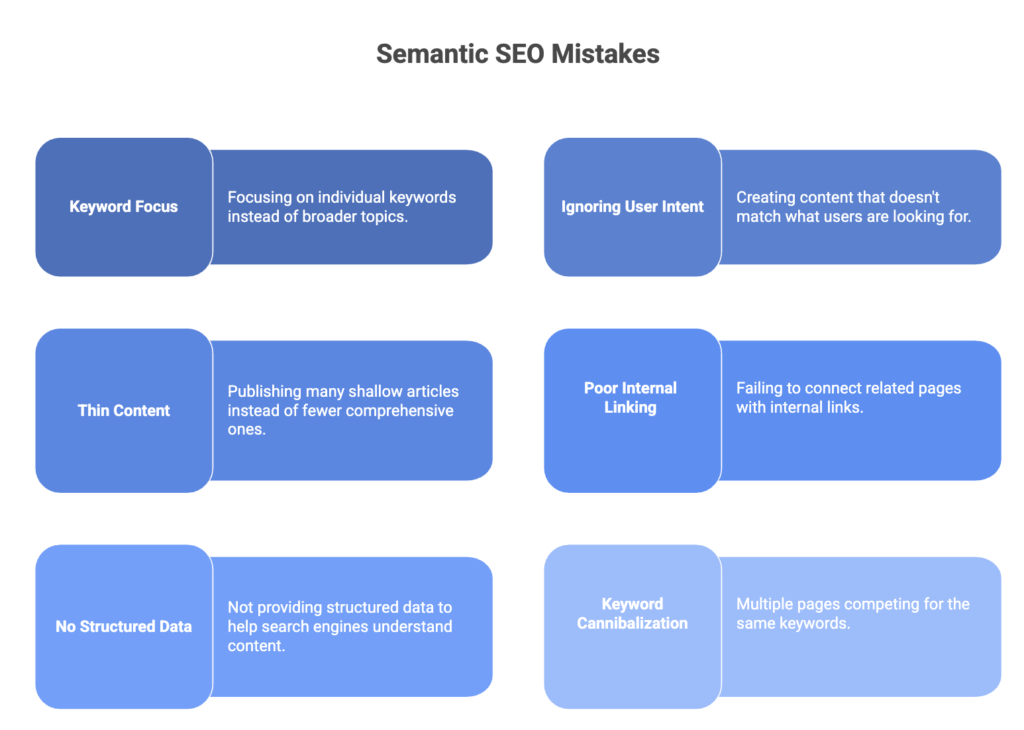
Mistake #1: Focusing on Keywords Instead of Topics
Problem: Creating separate pages for “project management software,” “project management tools,” and “PM platforms” when one comprehensive page would rank for all three.
Solution: Cluster semantically related keywords and serve them with single, authoritative pages.
Mistake #2: Ignoring User Intent
Problem: Creating informational content for commercial keywords, or vice versa.
Solution: Analyze search results for target keywords. What type of content ranks? Match that intent.
Mistake #3: Thin Content Across Too Many Pages
Problem: Publishing 50 shallow articles instead of 10 comprehensive ones.
Solution: Prioritize depth over breadth. Build topical authority with fewer, better pages.
Mistake #4: Poor Internal Linking
Problem: Creating great content that’s not connected to related pages.
Solution: Build deliberate internal link structures using topic maps and content clusters.
Mistake #5: No Structured Data
Problem: Relying on search engines to interpret your content without providing structured data.
Solution: Implement schema markup for all content types. This is especially critical for BOFU pages.
Mistake #6: Keyword Cannibalization
Problem: Multiple pages targeting the same keyword cluster, competing with each other.
Solution: Audit content for cannibalization and consolidate overlapping pages. Use canonical tags when necessary.
Semantic SEO for Different Business Models
For SaaS Startups
Focus on:
- Use case-specific content (semantic variations around how different customers use your product)
- Comparison pages (your tool vs. competitors)
- Integration guides (connecting your product to the broader martech ecosystem)
- Industry-specific landing pages (vertical-specific semantic content)
For E-Commerce
Focus on:
- Product category pages with comprehensive information
- Buying guides that cover all related considerations
- Product comparison pages
- Use case content (e.g., “best running shoes for flat feet”)
For B2B Services
Focus on:
- Service pages with semantic depth (not just lists of what you do)
- Industry expertise content demonstrating topical authority
- Case studies showing real-world applications
- Thought leadership establishing entity connections
The Semantic SEO Tech Stack for Startups
Essential tools for semantic SEO execution:
- Google Search Console: Performance data, indexing status, search queries
- Schema Markup Generator: Create structured data without coding
- Google Knowledge Graph Search API: Research entity relationships
- Answer the Public / AlsoAsked: Discover question-based long-tail keywords
- ChatGPT/Claude: Research competitor content, generate outlines, ideate angles
Avoid overcomplicating. Most startups need 2-3 tools maximum for effective semantic SEO.
Why Semantic SEO Is the Competitive Advantage Startups Need
Big companies have brand recognition and advertising budgets. Startups have agility and the ability to execute semantic strategies faster than enterprise competitors.
When you build semantic content:
- You rank for hundreds of keywords with fewer pages
- You appear in AI-powered search where discovery is happening
- You reduce reliance on paid advertising
- You build compounding assets that appreciate over time
- You demonstrate expertise that builds trust and authority