Product-led SEO is a content strategy that uses your product’s features, data, or functionality to generate thousands sometimes millions of SEO-optimized pages automatically. Think Zillow‘s individual property listings, Yelp’s business pages, or Canva’s template library. Instead of writing blog posts one at a time, you build systems that turn your product into a search-engine magnet.
For growth-stage startups trying to lower CAC and scale faster than bootstrapped content teams allow, product-led SEO is the closest thing to a growth hack that actually works. While traditional SEO might get you 50 solid articles in six months, a well-executed product-led strategy can launch 10,000 indexed pages in the same timeframe, each one answering a specific user query and funneling traffic directly into your product.
Here’s the kicker: this approach doesn’t just dominate Google. When executed correctly, it positions your brand to win in AI-powered search environments like ChatGPT, Gemini, and Perplexity. Because these AI agents prioritize structured, data-rich, authoritative content exactly like the pages product-led SEO generates.
Table of Contents
The Core Concept: Turn Your Product Into a Search Engine
Traditional content marketing follows a predictable path: identify keywords, write articles, build backlinks, wait for rankings. Product-led SEO flips this model. Instead of creating content about your product, you create content from your product.
The formula looks like this:
Your product data (user profiles, templates, tools, listings, comparisons) + programmatic page generation + SEO optimization = massive organic traffic at scale.
Why Startups Are Shifting Budget From Ads to Product-Led SEO
Your paid acquisition costs are probably climbing. Google’s average CPC has increased 15% year-over-year, and if you’re targeting competitive startup keywords, you’re likely paying $20-50 per click. Meanwhile, organic traffic, once you’ve built the infrastructure, costs essentially nothing to maintain.
The math is compelling: A client in the SaaS comparison space was spending $40K monthly on Google Ads with a customer acquisition cost around $380. After implementing product-led SEO (building automated comparison pages for their vertical), they now drive 45% of conversions from organic search at an effective CAC under $90.
But the real advantage isn’t just cost. It’s speed and scale. AI agents and automated page generation let you move faster than traditional agencies. You can test, iterate, and deploy at a pace that matches startup velocity not the six-month editorial calendars most SEO teams operate on.
The Three Pillars of Product-Led SEO That Actually Work
Programmatic Page Generation (The Scalability Engine)
This is where your product database becomes your content factory. You identify scalable templates—comparison pages, tool directories, location-based landing pages, user profiles, integration pages—and build systems to generate them automatically.
Example structure: If you’re a project management tool, you might create pages for “[Industry] project management,” “[Use case] workflow templates,” or “[Tool] vs [Competitor]” comparisons. Each page pulls from your product data: features, pricing, customer segments, integrations.
The quality bar matters here. Google (and AI search engines) can detect thin, templated content. Your pages need unique value real product screenshots, actual feature comparisons, genuine user data. The automation handles scale; your expertise ensures each page answers a real query better than existing results.
Intent Mapping (Converting Browsers Into Users)
Here’s where most product-led SEO strategies fail: they generate traffic to pages that don’t convert. A visitor landing on your “Email marketing tools for nonprofits” page should immediately see how your product solves that specific use case—not a generic homepage message.
Best practices:
- Match page content to search intent (informational vs. transactional)
- Include specific CTAs relevant to that page’s topic
- Show product features that matter for that use case
- Add social proof from similar users or industries
- Remove navigation friction, make the signup path obvious
When someone searches “AI SEO tools for startups,” they’re further down the funnel than someone searching “what is SEO.” Your product-led pages should reflect this with stronger commercial intent and clearer conversion paths.
Internal Linking Architecture (The Ranking Multiplier)
This is the unsexy part everyone ignores and why they plateau at 10,000 visits instead of 100,000. Your programmatic pages need to link intelligently to each other and to your core conversion pages.
Think of it like this: each new page you create should boost the authority of your most valuable pages through strategic internal links. If you generate 1,000 location-based landing pages, they should all link to your main product page and relevant feature pages, passing link equity and creating clear site hierarchy.
The AI search advantage: When ChatGPT or Perplexity crawls your site, a well-structured internal linking system helps these AI agents understand your site architecture, content relationships, and topical authority, making it more likely they’ll cite your pages as authoritative sources.
Real Talk: What Product-Led SEO Is NOT
Before you get too excited, let’s clear up misconceptions from a thread on r/SEO where u/agencyowner asked:
“Can we just spin up 10,000 AI-generated pages and rank overnight?”
No. Here’s what fails:
- Thin AI-generated pages with no real product integration
- Exact duplicate content with only city names swapped
- Pages that don’t match actual search demand
- Zero unique value compared to existing results
- No consideration for user experience or conversion
Google’s helpful content update specifically targets low-value programmatic content. Your pages need to be genuinely useful, answering real questions with real product data that no competitor can easily replicate.
The difference between spam and successful product-led SEO is simple: would this page exist if you weren’t trying to rank for it? If the honest answer is no, you’re building on shaky ground.
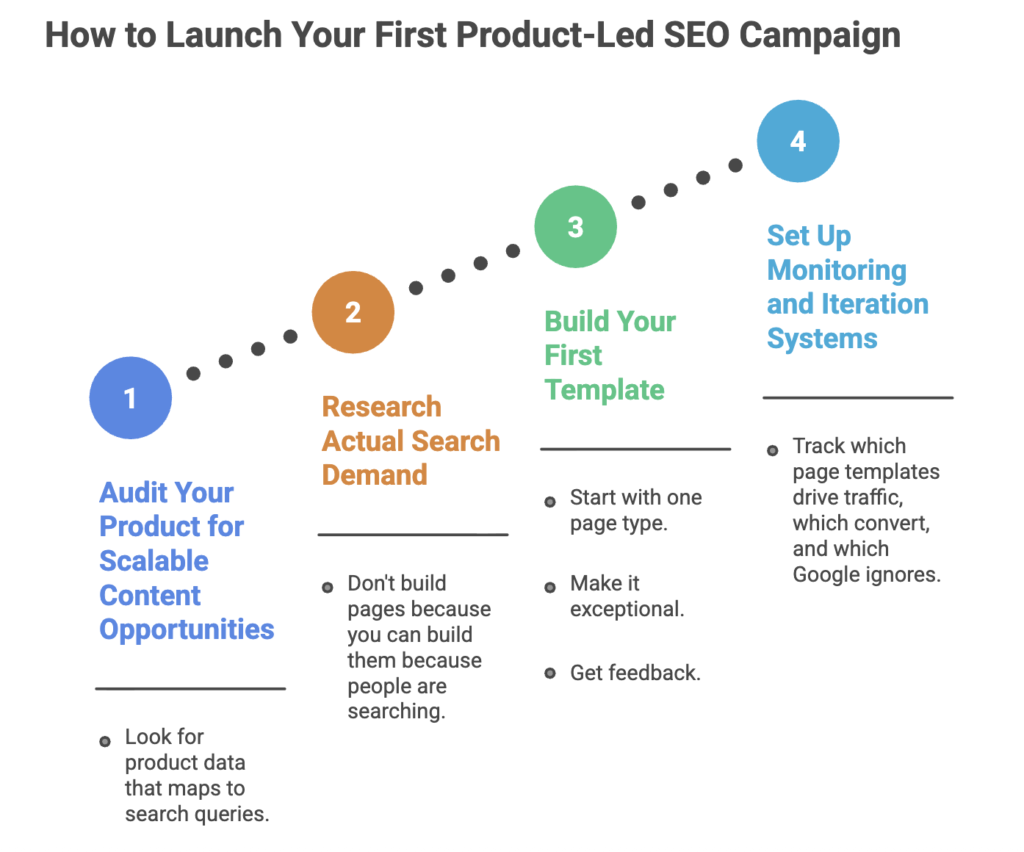
How to Launch Your First Product-Led SEO Campaign
Audit Your Product for Scalable Content Opportunities
Look for product data that maps to search queries. Do you have user-generated content? Comparison data? Location-specific information? Feature combinations? Industry applications? Each represents potential page templates.
Research Actual Search Demand
Don’t build pages because you can build them because people are searching. Use keyword research tools to validate that your template ideas have real search volume. A common mistake: creating 5,000 pages for searches that get 10 monthly queries each.
Build Your First Template
Start with one page type. Make it exceptional. Get feedback. Optimize for conversions. Only after you’ve proven one template works should you scale to thousands of pages. This iterative approach testing fast, learning faster is how data-driven growth teams operate.
Set Up Monitoring and Iteration Systems
Track which page templates drive traffic, which convert, and which Google ignores. Use this data to refine templates, adjust internal linking, and double down on what works. Product-led SEO isn’t “set it and forget it” it’s “launch fast, measure everything, iterate constantly.”
The GEO Angle: Why This Strategy Wins in AI Search
Here’s something that leverages AI search optimization: product-led SEO naturally aligns with how AI agents retrieve and present information. When ChatGPT answers a query about “best CRM for real estate startups,” it favors content that’s:
- Structured with clear data points
- Specific to the query context
- Authoritative (backed by actual product features)
- Comprehensive without fluff
Your programmatic product pages, if built right check every box. They’re inherently data-rich, contextually specific, and demonstrate clear expertise. This positions you to capture traffic not just from Google, but from the next generation of search that’s happening inside LLM interfaces.
Think about citation opportunities. When an AI agent needs to recommend tools, compare features, or explain use cases, it pulls from pages that demonstrate clear authority and structure. Your product-led SEO pages become the source material these AI systems reference a competitive moat that’s harder to replicate than traditional blog content.
When Product-Led SEO Makes Sense (And When It Doesn’t)
This strategy works best if you have:
- Product data that maps to search queries (listings, comparisons, templates)
- Engineering resources to build page generation systems
- A product that serves multiple use cases, industries, or segments
- Patience for 3-6 months of setup before seeing major returns
This strategy struggles if:
- Your product serves one narrow use case with limited keyword variations
- You can’t generate genuinely unique value on each page
- You lack the technical infrastructure to support thousands of pages
- Your product isn’t differentiated enough to stand out in comparisons
A consulting firm with five core services shouldn’t try product-led SEO—they should focus on authority content and thought leadership. But a marketplace, SaaS platform, or tool with hundreds of features, integrations, or applications? That’s where this approach dominates.
The Bottom Line: Speed, Scale, and Sustainable Growth
Product-led SEO isn’t just about traffic volume, though the numbers can be impressive. It’s about building a sustainable growth channel that gets stronger over time, lowers your customer acquisition costs, and positions your brand as the authoritative source in your space.
For growth-stage startups competing against better-funded competitors, it’s one of the few strategies that lets you move faster and build lasting competitive advantages. While your competitors are paying increasing CPCs for the same traffic, you’re capturing users at the exact moment they’re searching for solutions your product provides.
And as search continues evolving toward AI-powered answers, the companies that have already built deep, structured, product-integrated content systems will have a massive head start. Because whether someone finds you through Google, ChatGPT, or whatever comes next, the fundamentals remain the same: be the most helpful, specific, and authoritative answer to their question.
That’s what product-led SEO delivers at scale, at speed, and at a cost structure that actually makes sense for startups focused on sustainable growth.