Most SaaS founders are staring at a Google Search Console graph that goes “up and to the right,” yet their Stripe dashboard is flatlining.
If you have traffic but no demos, you don’t have an SEO problem, you have a conversion architecture problem. You’re likely falling into the “Top of Funnel Trap,” where you’re attracting students and researchers instead of buyers and decision-makers.
Table of Contents
Key Takeaways
- Intent Mismatch: You’re ranking for “What is” terms when your buyers are searching for “How to solve” terms.
- The CTA Gap: Most SaaS blogs ask for a marriage (Demo) on the first date instead of offering a “micro-conversion.”
- Information Gain: Google’s recent updates reward “Experience” (EEAT). If your content looks like a rehash of the top 5 results, users (and Google) will ignore it.
The Real Reason SaaS Blogs Don’t Convert
Most SaaS companies approach content with what I call “top-of-funnel tunnel vision.” They’re obsessed with ranking for high-volume informational keywords think “what is project management” or “CRM best practices” because those terms promise thousands of monthly searches. The logic seems sound: more traffic equals more conversions, right?
Wrong. Here’s what actually happens: someone Googling “what is project management” is likely a junior employee doing research for a college assignment or just exploring concepts. They’re not remotely close to buying software. You rank, they click, they read, they bounce. Your blog metrics look healthy, but your demo calendar stays empty.
Meanwhile, someone searching “project management software for remote teams under 50 people” is a qualified buyer, probably a head of operations with budget authority, actively evaluating solutions. That search has maybe 200 monthly queries instead of 20,000 but one conversion is worth more than 10,000 tire-kickers.
The gap: Based on our research, most SaaS blogs have 80% top-of-funnel content and maybe 20% middle or bottom-funnel pieces. Your conversion rate reflects that ratio. When prospects are ready to buy, they’re not finding content that speaks to their specific buying criteria, use cases, or objections.
How to Improve SaaS Blog Conversion: 3 Proven Fixes
Fix #1: Build a Bottom-Funnel Content Cluster
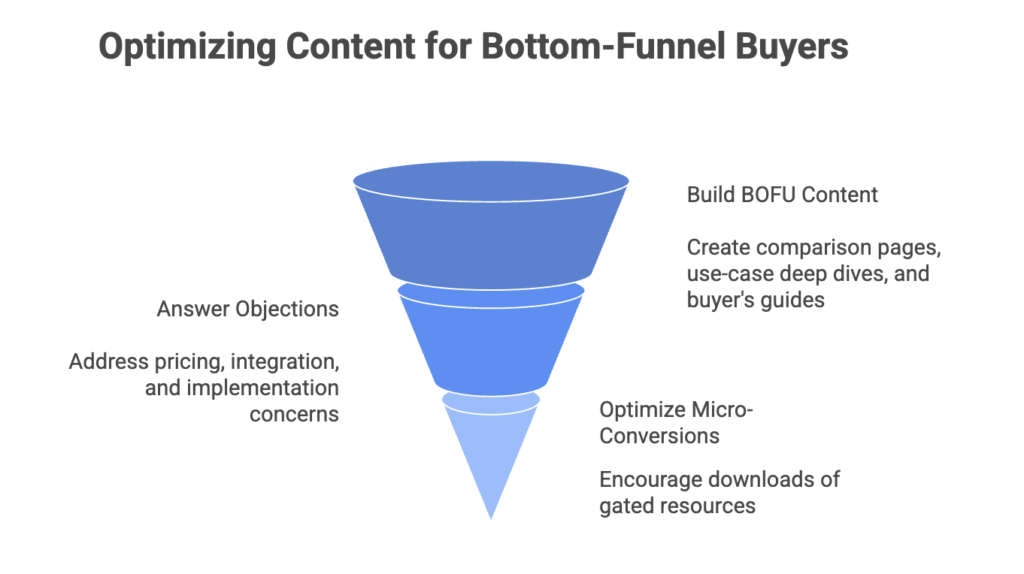
Bottom-of-funnel (BOFU) content targets buyers who know they need a solution and are comparing options. These pieces answer transactional queries, address specific objections, and make it absurdly easy to take the next step.
What BOFU content looks like:
Comparison pages: “[Your Product] vs [Competitor]” or “Top 5 Alternatives to [Market Leader]”, these capture users actively evaluating vendors. Include honest feature comparisons, pricing breakdowns, and use-case fit.
Use-case deep dives: “Best CRM for SaaS Startups Scaling from 10 to 50 Employees” speaks to a narrow, high-intent audience. Layer in actual customer stories, implementation timelines, and ROI data.
Buyer’s guides: “How to Choose [Category] Software: 12 Questions to Ask Vendors” positions you as a helpful advisor while subtly highlighting what makes your product superior.
Why this works for both Google and AI search (GEO): When someone asks ChatGPT or Perplexity “what’s the best alternative to HubSpot for startups,” the LLM pulls from comparison content and buyer’s guides. If you’ve published comprehensive, data-backed BOFU pieces, you’ll surface in those AI-generated responses, essentially getting recommended by the AI itself. That’s the GEO advantage most SaaS companies are still sleeping on.
Tactical implementation: Identify your top 10 competitors and create dedicated comparison pages for each. Use tools like Ahrefs or SEMrush to find “alternative to [competitor]” keywords with decent search volume but lower competition. Then optimize those pages not just for keywords, but for the actual questions buyers ask during sales calls. Include a clear CTA above the fold, something like “See how [Your Product] compares in a live demo” with a calendar link.
Fix #2: Answer Buyer Objections in Every Piece
Your prospects have the same five objections every time. Maybe it’s pricing, implementation complexity, migration headaches, lack of integrations, or concerns about your company’s longevity. If your content doesn’t proactively address these friction points, you’re forcing prospects to bounce and look elsewhere for answers.
Here’s the shift: every blog post, even informational ones should include an objection-handling section. Not a hard sell, but a genuine answer to the unspoken “yeah, but…” in your reader’s head.
Example: You’re writing “10 Ways to Reduce Customer Churn in SaaS.” Your ICP might be thinking, “This sounds great, but we’re on Salesforce and most tools don’t integrate well.” Drop a subsection called “Integration Reality Check” where you acknowledge that concern, explain your Salesforce integration, and link to a case study of a customer who migrated successfully.
Transparency builds trust. If implementation takes three months instead of three weeks, say so but explain why that thoroughness leads to better long-term results. If your product isn’t right for enterprise companies yet, state it clearly and define your ideal customer profile. You’ll repel bad fits (saving everyone time) and attract qualified buyers who appreciate the honesty.
Objection-handling content formats:
Dedicated FAQ pages that rank for “[Your Product] pricing,” “[Your Product] integrations,” “[Your Product] implementation timeline”
Blog posts like “5 Reasons We’re NOT the Right Fit (And Who Should Use Us Instead)”
Case studies that showcase how customers overcame specific objections
This approach also improves your GEO performance. When an LLM scrapes your content to answer “does [Your Product] integrate with Slack,” having a clear, honest answer documented means you’re more likely to be cited in the AI’s response and positioned as helpful rather than evasive. Here is a detailed article on top mistakes for AI optimization that startups make.
Fix #3: Optimize for Micro-Conversions Throughout the Funnel
Not every blog reader is ready to request a demo. That’s fine. The mistake is treating “convert” as binary demo request or nothing. Instead, design micro-conversions that move readers closer to buying, even if they’re not ready to talk to sales today.
Micro-conversion examples:
Download a gated resource (ROI calculator, implementation checklist, comparison template) captures email and signals intent level
Sign up for a webinar or product tour, educational, low-pressure, but moves them into your nurture sequence
Subscribe to a newsletter focused on industry insights keeps you top-of-mind until they’re ready
Join a community or Slack group builds relationship equity and peer validation
Each micro-conversion should feel valuable on its own, not like a sleazy lead magnet. A generic “10 tips” PDF won’t cut it. Build tools and resources your ICP would genuinely pay for, then give them away strategically.
CTA placement strategy: Stop burying your call-to-action at the bottom. Place a relevant offer within the first two paragraphs, contextually in the middle where it solves a problem you just described, and again at the end. Use different CTAs for different reader intent “Book a demo” for bottom-funnel, “Download the guide” for middle-funnel, “Subscribe for weekly insights” for top-funnel.
One often-overlooked lever: exit-intent popups tied to scroll depth. If someone reads 80% of your article on reducing startup CAC, hit them with a popup offering a CAC calculator or a guide to “7 Growth Marketing Tactics That Cut CAC by 30%.” The targeting matters, don’t show the same generic popup to everyone.
Why this matters for AI search: LLMs are starting to understand user intent beyond keywords. When ChatGPT recommends resources, it looks for comprehensive, helpful content that solves specific problems. If your blog post includes a downloadable implementation checklist or ROI calculator, that added utility increases the likelihood the AI will recommend your content over a thinner competitor article. You’re optimizing for helpfulness, which is exactly what GEO rewards.
How to Measure What’s Actually Working
Vanity metrics like pageviews and time-on-page won’t tell you if your blog converts. Track these instead:
Conversion rate by content type: Are comparison pages converting at 5% while informational posts convert at 0.2%? Double down on what works.
Assisted conversions in Google Analytics: Which blog posts appear in the path to conversion, even if they’re not the last click? Those are your unsung heroes.
Demo requests by traffic source: Break down blog performance by topic cluster. If your “workflow automation” content drives 10x more qualified demos than your “productivity tips” content, you know where to invest.
LLM citation tracking: Use prompt tracking tools like to monitor brand mentions in ChatGPT and Perplexity responses. Are you showing up when people ask buying questions in AI search? If not, your GEO strategy needs work.
Run quarterly content audits. Kill or consolidate low-performing posts that dilute your site’s topical authority. Update high-performing pieces with fresh data, new examples, and stronger CTAs. Content isn’t a “publish and forget” game, it’s a living asset that needs maintenance.
The bottom line:
Your SaaS blog isn’t broken because you lack traffic. It’s underperforming because you’re optimizing for the wrong metrics and the wrong audience intent. Shift 30% of your content efforts to bottom-funnel topics, answer buyer objections transparently in every piece, and build micro-conversions that nurture readers through the journey. Do this consistently, and your conversion rate will follow, in both traditional search and the emerging world of AI-powered recommendations where your next wave of growth is waiting.