
Programmatic SEO lets you build hundreds or thousands of landing pages automatically by combining templates with structured data, think Zillow’s city pages or Yelp’s business listings. For SaaS companies, this means creating targeted pages for every use case, integration, comparison, or location your product serves, capturing long-tail search traffic that would be impossible to write manually.
If you’re a growth-stage SaaS founder watching your CAC climb while organic traffic flatlines, programmatic SEO might be the unlock you’ve been ignoring. But here’s the catch: most companies botch the execution. They either spam Google with thin content or get paralyzed by the technical complexity. This guide will show you how to do it right.
Table of Contents
Why SaaS Companies Are Investing in Programmatic SEO
Traditional content marketing has a brutal math problem. Your team writes 50 blog posts per quarter. Maybe 10 rank well. You’re lucky if five drive meaningful conversions. Meanwhile, your paid acquisition costs keep rising, and every competitor is bidding on the same keywords.
Programmatic SEO breaks this ceiling. Instead of writing individual pages for “project management software for architects,” “project management software for contractors,” and 500 other variations, you build one template and populate it with data. The result? You can own entire keyword categories instead of fighting over scraps.
The timing couldn’t be better. Google’s algorithms have gotten smarter at rewarding comprehensive content that actually helps users, and AI-powered search engines like ChatGPT and Perplexity are indexing this kind of structured information beautifully. When someone asks “best CRM for real estate agents in Austin,” your programmatically generated page can surface in both traditional search and LLM responses.
What Makes a Programmatic Page Actually Valuable (Not Spam)
Here’s where most companies fail in product led SEO: they confuse automation with value. Spinning up 10,000 pages that are 95% identical except for a keyword swap isn’t SEO, it’s pollution.
So? “How do you prevent programmatic pages from being flagged as duplicate content?” The answer is deceptively simple: each page needs to provide genuinely unique value to its specific audience.
This means your template should include:
Dynamic data points that change meaningfully. If you’re building location pages, include actual local statistics, regulations, or market conditions. For use-case pages, pull in relevant case studies, pricing variations, or feature comparisons specific to that industry.
User-generated content where possible. Reviews, testimonials, or community questions tied to that specific variation add authenticity and freshness. One SaaS company embeds industry-specific Slack or Reddit discussions on each use-case page.
Unique supporting content. Your core template might be similar, but the FAQs, examples, and related resources should reflect the page’s specific intent. A “marketing automation for e-commerce” page should reference abandoned cart flows and product recommendation engines, not B2B lead scoring.
The test is simple: If you showed five of your programmatic pages to a user without URLs visible, could they immediately tell which specific need each one addresses? If not, you’re building spam.
The Four-Step Framework to Launch Your First 1,000 Pages
Let me walk you through the exact process we’ve seen work for growth-stage SaaS companies. This isn’t theoretical, it’s what actually ships pages that rank and convert.
Step 1: Identify Your Data-Rich Opportunity
Start by finding the intersection of three things: abundant search volume, structured data you can access, and genuine variations in user intent.
The best SaaS programmatic opportunities usually fall into these categories:
- Comparison pages (“Competitor X vs Competitor Y,” “Best alternative to Tool Z”)
- Integration pages (Your product + every tool in your ecosystem)
- Use-case pages (Your solution for different industries, roles, or workflows)
- Location-based pages (If your product has local relevance or compliance variations)
- Feature-specific pages (“How to accomplish specific task with your product”)
Run a quick audit: Export your Google Search Console data and filter for queries that include modifiers like “for [industry],” “vs,” “alternative,” or location names. Look for patterns where you’re ranking positions 8-20 on page one or top of page two. These are winnable keywords where a dedicated page would likely jump you to positions 1-5.
Pro tip for AI SEO: Many LLMs struggle with nuanced comparisons or local variations. If you build comprehensive comparison pages, you’re creating training data that positions your product favorably when users ask ChatGPT or Perplexity for recommendations.
Step 2: Build Your Data Foundation
This is where most projects stall. You need clean, structured data before you can template anything.
Create a spreadsheet or database with these columns:
- Primary keyword/variation
- Search volume (use Ahrefs, SEMrush, or even Google Keyword Planner)
- Title tag template
- Meta description template
- H1 variation
- Unique data points (3-5 specific to this variation)
- Related internal links
- Relevant external sources (for credibility)
For a use-case programmatic build, your data might look like this: “project management for construction” with search volume 2,400/month, unique data points including “integrates with Procore, handles RFI workflows, supports multi-site project tracking,” plus two construction-specific case studies and compliance notes about OSHA documentation.
The quality of this data directly determines the quality of your pages. Spend time here. If you’re pulling in third-party data, ensure you have the rights to use it and that it’s actually accurate.
Step 3: Design Templates That Convert, Not Just Rank
Your template needs to serve two masters: Google’s algorithms and human visitors who will actually use your product.
Here’s a structure that consistently performs well:
- Above the fold: Clear H1 with your target keyword, a value proposition specific to this variation, and a CTA (usually a free trial or demo). For “CRM for real estate agents,” your H1 might be “Real Estate CRM That Actually Tracks Commissions and Referrals,” not generic “Best CRM Software.”
- Social proof section: Customer logos, testimonials, or quick wins relevant to this use case. If you don’t have vertical-specific customers yet, use adjacent examples or broader social proof positioned carefully.
- Core feature comparison: Three to five features that matter most for this variation, with concrete examples. Avoid generic feature lists—tie everything to the specific pain point.
- Detailed content block: This is where your programmatic data shines. Include pricing comparisons, integration details, workflow examples, or local considerations. Aim for 800-1,200 words of genuinely useful information.
- FAQ section: Four to six questions specific to this variation. These are gold for ranking featured snippets and feeding LLM knowledge bases.
- Conversion focus: Multiple CTAs throughout, but don’t make every paragraph a sales pitch. The best converting programmatic pages educate first, sell second.
One critical note: Your template should be responsive not just in design but in logic. If certain data points don’t exist for a variation, the template should gracefully handle that gap rather than leaving empty sections or generic filler.
Step 4: Publish Strategically and Monitor Quality
Don’t dump 1,000 pages live on Tuesday. Google’s indexing budget is real, and a massive influx of new URLs can trigger manual reviews.
Launch in waves of 100-300 pages, starting with your highest-volume or highest-intent keywords. This lets you catch template issues early and gives you data to optimize before scaling further.
Set up monitoring immediately:
Create a dedicated segment in Google Analytics for your programmatic pages. Track not just traffic but engagement metrics, if your bounce rate is above 70% or time on page is under 30 seconds, you’ve got a quality problem.
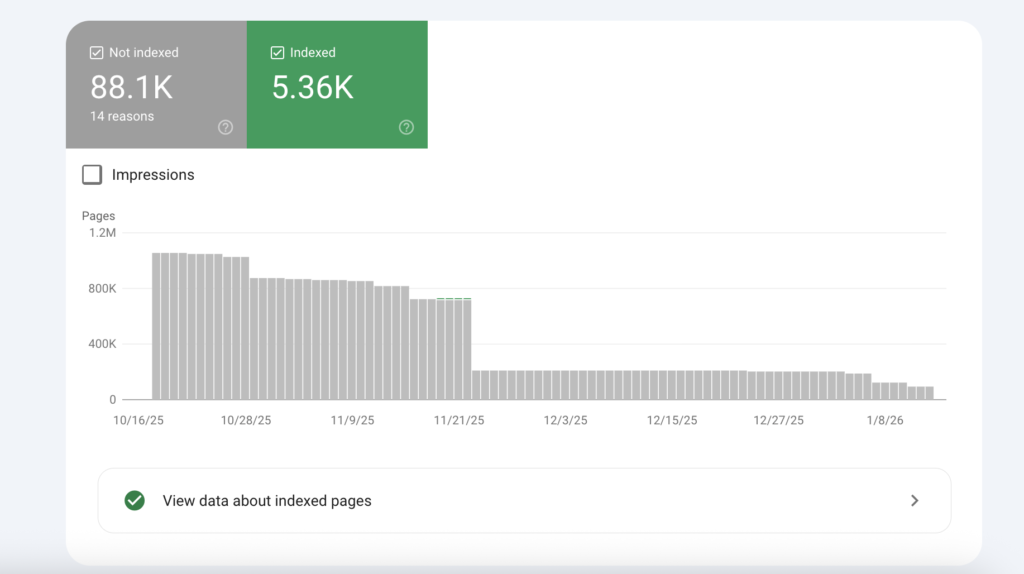
Use Google Search Console to monitor index coverage. If Google is choosing not to index large percentages of your pages, it’s a signal that they’re too similar or low-value.
Build a simple dashboard showing rank tracking for a sample of 50-100 representative keywords across your variations. You don’t need to track all 1,000 daily, but you need directional data.
“How long before programmatic pages start ranking?”
Expect 4-8 weeks for initial indexing and positioning, with meaningful traffic building over 3-6 months. Pages targeting lower-competition variations will rank faster and validate your approach.
Internal Linking: The Secret Weapon Nobody Uses Well
Here’s a tactical advantage most companies miss: programmatic pages create an internal linking goldmine if you architect it properly.
Every programmatic page should link to:
- Your main product/homepage
- Relevant blog content that supports the use case
- 3-5 related programmatic pages (other industries, adjacent comparisons, etc.)
- A primary conversion page (pricing, demo request)
But the magic happens in reverse: Make sure your existing high-authority pages link back to relevant programmatic pages. If you have a popular blog post about marketing automation, add contextual links to your “marketing automation for e-commerce” and “marketing automation for SaaS” programmatic pages.
This creates a link architecture where authority flows from your established content to new programmatic pages, helping them rank faster while also keeping users engaged across multiple pages. One client saw average session duration increase 40% simply by improving internal linking between programmatic and editorial content.
Making Your Pages GEO-Ready (Because Google Isn’t the Only Game Anymore)
Traditional SEO optimizes for Google’s crawler. GEO (generative engine optimization), optimizes for how LLMs understand and cite your content. The good news? Programmatic SEO done well is naturally GEO-friendly.
Structured data is your friend. Implement schema markup for SoftwareApplication, Product, FAQPage, and HowTo where relevant. LLMs parse structured data more reliably than unstructured content, so your programmatic pages become prime source material when someone asks ChatGPT “what’s the best CRM for real estate agents?”
- Write in clear, declarative sentences. LLMs cite sources that state facts plainly. Instead of “Our platform might be a good fit for construction teams looking for better project tracking,” write “Construction project managers use our platform to track RFIs, submittals, and change orders in one system.”
- Include concrete comparisons and data points. When LLMs answer comparison queries, they pull from pages that directly compare features, pricing, or capabilities. Your programmatic comparison pages should include factual, up-to-date information in scannable formats.
- Build FAQ sections that answer voice search queries. Many AI-powered searches are conversational. Your FAQ content should mirror how people actually ask questions: “How much does project management software cost for construction companies?” not “Pricing information.”
The companies winning in AI search aren’t doing anything magical, they’re creating comprehensive, well-structured content that answers specific questions directly. Programmatic SEO, when done right, does exactly that at scale.
Common Pitfalls (and How to Avoid Them)
- Thin content at scale. If your pages are under 500 words or lack unique value, you’re building a penalty waiting to happen. Better to launch 200 excellent pages than 2,000 mediocre ones.
- Ignoring search intent. Not every keyword variation deserves a page. If “CRM for plumbers” gets 10 searches per month and you have zero plumber customers, you’re wasting crawl budget and diluting your authority.
- Static templates that never improve. Your first template won’t be perfect. Plan to iterate based on performance data, user feedback, and ranking patterns. The best programmatic SEO programs treat templates as living documents.
- Forgetting about maintenance. Programmatic pages need updates when your product changes, competitors shift, or market conditions evolve. Budget time for quarterly reviews and refreshes.
- Over-optimizing for keywords, under-optimizing for humans. If your pages read like a robot wrote them, congratulations, you’ve built exactly the kind of content Google’s algorithms are trained to demote.
The Metrics That Actually Matter
Forget vanity metrics. Here’s what determines whether your programmatic SEO investment pays off:
- Organic traffic from programmatic pages as a percentage of total organic. You should see this climb from 0% to 20-40% over 6-12 months if execution is solid.
- Conversion rate from programmatic traffic vs. other organic. If these pages convert at less than 50% of your blog or main page traffic, you’ve got an intent mismatch or quality issue.
- Average ranking position for target keywords. Track your core 100 variations weekly. You want to see steady movement from positions 10-20 into the top five.
- Index coverage rate. Google should index at least 70-80% of your published programmatic pages. Lower rates mean quality problems.
- Engagement metrics. Pages per session and time on site should stay within 20% of your site average. Massive drops indicate users aren’t finding value.
One SaaS company we worked with tracked “days to first conversion” from each programmatic page cluster. They discovered their integration pages converted 3x faster than use-case pages, which shifted their prioritization entirely.
Frequently Asked Questions
How long does it take to build a programmatic SEO system from scratch?
For most SaaS companies, expect 6-10 weeks from strategy to first launch. This includes 2-3 weeks of data collection and validation, 2-3 weeks of template development and testing, and 1-2 weeks of initial publishing and QA. The technical implementation (connecting templates to databases, setting up automation) usually takes 1-2 weeks with a competent developer.
Do I need a developer to launch programmatic SEO pages?
It depends on scale and your existing tech stack. For 50-100 pages, you might get away with WordPress plugins or no-code tools like Webflow + Airtable. For 1,000+ pages, you’ll want custom development—usually Next.js, Gatsby, or a headless CMS setup. Budget $10-30K for proper technical infrastructure if you’re starting from zero.
Will Google penalize my site for publishing hundreds of similar pages?
Not if each page provides genuine unique value. Google penalizes duplicate content and thin content, not scale. The test: Would a user searching for the specific variation find your page more helpful than a generic alternative? If yes, you’re fine. If you’re just keyword-stuffing templates, you’re at risk. Focus on quality per page, not quantity of pages.
How do programmatic pages perform in AI-powered search like ChatGPT or Perplexity?
Exceptionally well when structured properly. LLMs prioritize comprehensive, factual content that directly answers specific queries, exactly what good programmatic pages deliver. Use schema markup, clear headings, and declarative sentences to maximize citation probability. We’ve seen programmatic comparison pages get cited 3-5x more often than generic blog content in LLM responses.
What’s the minimum viable dataset to start programmatic SEO?
You need at least 50-100 variations with meaningful differentiation to justify the infrastructure investment. Below that, you’re better off writing custom pages. Look for opportunities where you have structured data (integrations, locations, use cases) and search volume across multiple long-tail variations. If your target keywords collectively drive less than 10,000 monthly searches, programmatic SEO probably isn’t your highest-leverage growth channel yet.