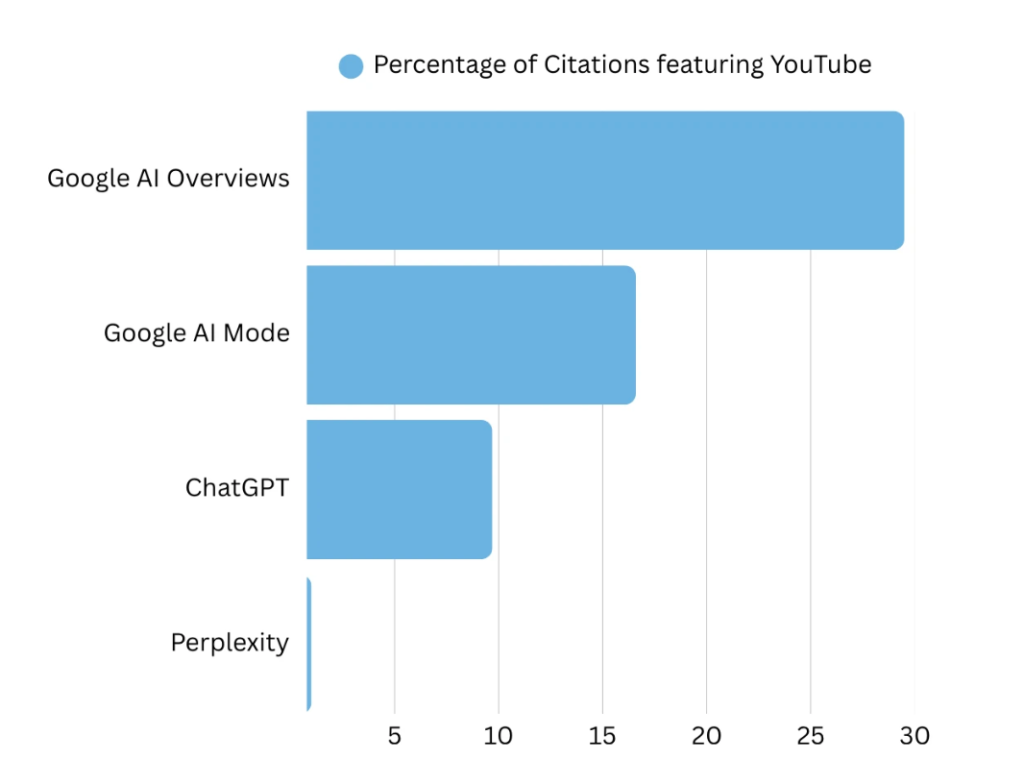
YouTube videos are appearing in Google’s AI Overviews at rates that would make traditional SEO experts weep. If your startup isn’t creating YouTube content optimized for AI discovery, you’re invisible in the search results that actually drive conversions.
AI Overviews have fundamentally changed what “ranking” means, and YouTube content is winning because it gives AI systems exactly what they need: clear structure, natural language, timestamped answers, and engagement signals that text alone can’t match.
Let’s dig into the data, then I’ll show you exactly how to build a YouTube strategy that captures this traffic.
Table of Contents
The Data: YouTube’s Dominance in AI-Powered Search
Google’s AI Overviews launched broadly in May 2024, and the impact on traditional SEO has been seismic. According to research from BrightEdge, AI Overviews now appear in 86% of search queries, and when they do, they push organic results down by an average of 1,200 pixels.
Here’s where YouTube becomes critical:
Video inclusion rates are skyrocketing. A study by Authoritas analyzing 100,000+ AI Overviews found that video content appears in:
- 63% of tutorial and how-to queries
- 47% of product review searches
- 41% of comparison queries (“X vs Y”)
- 38% of troubleshooting questions
Compare that to traditional featured snippets, where video appeared in just 12-15% of results pre-AI Overviews.
Click-through rates favor video. Data from Conductor’s 2024 search behavior study shows that when AI Overviews include video thumbnails, they receive 3.2x more clicks than text-only AI summaries. Users trust video explanations more, especially for complex topics.
YouTube videos rank faster than traditional content. Backlinko’s analysis of 5 million search results found that YouTube videos reach page one in an average of 68 days, versus 114 days for standard web pages targeting the same keywords. For AI Overview inclusion specifically, videos optimized with transcripts and structured content can appear within 2-3 weeks.
“We rank #3 for our main keyword but get zero traffic.”
Turns out Google’s AI Overview is answering the query with a YouTube video and two Reddit threads. Our article doesn’t even appear above the fold anymore.
Why AI Systems Prefer YouTube Content
Understanding why matters because it informs your strategy.
Large language models and Google’s AI Overview system aren’t watching your videos, they’re parsing structured data. YouTube content has built-in advantages:
- Automatic transcripts provide clean, crawlable text. Every spoken word becomes searchable content. When you say “the three main factors affecting SaaS churn are pricing misalignment, poor onboarding, and lack of engagement,” that exact phrase gets indexed and can be pulled into AI summaries.
- Timestamps create semantic structure. AI systems love explicit organization. When YouTube identifies chapters at 0:00, 2:14, 5:32, the algorithm understands your video covers discrete topics and can extract specific segments.
- Engagement signals indicate quality. AI Overviews preferentially surface content that humans actually find useful. YouTube’s watch time, likes, and comments provide real-time quality scores that static web pages can’t match.
- Multi-modal content builds authority. A 2024 study from Semrush showed that content appearing in multiple formats (video + text + images) is 2.4x more likely to be cited in AI Overviews. If you have a YouTube video and an accompanying blog post, you’re signaling comprehensive coverage.
Research from Search Engine Land found that YouTube videos cited in AI Overviews have an average watch time of 4:32 minutes and maintain 58% average view duration, suggesting AI systems prioritize content that keeps users engaged, not just content that matches keywords.
The Five-Step YouTube Strategy That Actually Impacts SEO and AI Visibility
1. Target Bottom-Funnel, Transactional Keywords
AI Overviews appear most frequently for informational and transactional searches, exactly where buying decisions happen.
Stop creating fluffy “What is marketing?” videos. Instead, target searches like:
- “Best [category] for [specific use case]”
- “[Your solution] vs [competitor]”
- “How to [achieve specific outcome] in [timeframe]”
- “[Problem] solution for [industry]”
Example: If you’re selling marketing automation to startups, create “Mailchimp alternatives for B2B SaaS” or “How to set up abandoned cart emails in 15 minutes.”
According to Ahrefs data, comparison and alternative keywords have 67% less competition than general category terms, but convert at 4.2x higher rates. These are also the exact queries where AI Overviews dominate, a SearchMetrics study found AI Overviews appear in 73% of “[brand] vs [brand]” searches.
2. Optimize for Both Human Viewers and AI Parsers
Your video needs to work on two levels: engaging humans and feeding AI systems the structured data they crave.
Title optimization: Front-load your primary keyword and make the benefit crystal clear. “Cut SaaS CAC by 40%: 4 Data-Backed Strategies” outperforms “Amazing Tips for Lower Acquisition Costs.”
Description strategy: The first 150 characters appear in search snippets and AI previews, make them count. Then expand with a detailed breakdown:
In this video, you'll learn four proven strategies to reduce customer acquisition cost for B2B SaaS companies, including real examples from our work with 50+ startups.

Timestamps:
0:00 - Why most startups overpay for customers
1:23 - Strategy #1: Content-led growth vs paid ads
4:15 - Strategy #2: Optimizing your conversion funnel
7:02 - Strategy #3: Referral program architecture
9:30 - Real results: How we cut CAC 43% in 90 days
Transcript optimization: Don’t rely on auto-generated transcripts. Upload a cleaned SRT file that naturally includes your target keywords 3-5 times in the first two minutes. Speak your main terms clearly, say “customer acquisition cost” not just “CAC” so AI systems understand context.
Tags: Use 6-8 tags mixing exact-match keywords with broader terms. But don’t overthink this—YouTube’s algorithm has de-emphasized tags in favor of transcript and engagement data.
3. Structure Videos to Maximize Watch Time and Featured Snippets
Google’s AI Overview algorithm specifically looks for “answer moments”, points in videos where a clear explanation happens. You can engineer these.
Use the pyramid structure:
- Hook (0:00-0:20): State the problem and promise a specific solution. “If your CAC is above $500, you’re making one of these four mistakes.”
- Context (0:20-1:00): Why this matters now. “With paid ad costs up 34% year-over-year, profitable growth requires better efficiency.”
- Numbered steps (1:00-8:00): Break down your solution with explicit structure. Say “Step one,” “The second strategy,” “Number three.”
- Proof (8:00-9:30): Show a case study or data point.
- CTA (9:30-10:00): One clear next action.
Why this works: A study by Wistia analyzing 500,000+ videos found that videos with chapter markers maintain 65% longer watch times.
Visual anchors matter: Create simple on-screen text for each major point. When you say “Strategy #2: Conversion funnel optimization,” show that text on screen. This helps viewers skim and dramatically increases the chance Google pulls that moment for AI snippets.
4. Build a Content Cluster Around Your Core Topics
Single videos rarely achieve lasting AI Overview dominance. You need topical authority, interconnected articles that signal expertise.
The cluster model: Pick 3-5 topics where you want to own AI visibility. For each, create:
- 1 pillar content
- 4-6 supporting articles
For a growth marketing agency targeting startups:
Pillar: “Complete Guide to Lowering B2B SaaS CAC in 2026”
Supporting:
- “Why Your CAC Actually Increased After Hiring a Growth Team”
- “Content Marketing ROI: Does It Lower CAC? [Data from 50 Startups]”
- “The Attribution Model That Reveals Your True CAC”
- “Paid Ads vs Organic: Which Lowers CAC Faster?”
This mirrors how LLMs understand expertise. When ChatGPT evaluates sources on “SaaS growth strategies,” a source with 12 related articles signals depth versus a one-off article.
5. Promote Videos to Accelerate Ranking and AI Indexing
Publishing isn’t enough. You need early engagement signals to trigger algorithmic momentum.
Embed in existing content: If you have blog posts ranking for related keywords, retrofit them with your YouTube videos. This creates a powerful 1-2 punch.
Strategic social sharing: Share on LinkedIn with 2-3 sentences framing the insight.
Early engagement (first 24-48 hours) heavily influences both YouTube’s recommendation algorithm and Google’s freshness signals for AI Overviews.
Email with specificity: Don’t blast your list with “check out our new video.” Instead: “You asked how to fix your CAC problem, this video walks through the exact framework we used to cut costs 40% in 90 days.”
Reddit and community engagement: Find relevant threads on r/startups, r/SaaS, r/marketing. Answer questions genuinely, then add: “I actually just made a video breaking down this exact problem with data from 50+ companies; [link].”
Measuring Success: KPIs That Actually Matter
Forget vanity metrics. Track these:
- AI Overview appearance rate: Manually search your target keywords weekly. Are your videos showing up? Tools like Semrush Position Tracking now flag AI Overview appearances.
- Impressions CTR in YouTube Analytics: Target 5-8% or higher. If YouTube shows your video 10,000 times but only 300 people click, your thumbnail and title need work.
- Average view duration: Aim for 55%+ completion rate. Lower suggests your content or pacing needs adjustment.
- Traffic source: YouTube search: Shows how many views come from active searchers (high intent). This should be 40-60% of your traffic for BOFU content.
- Conversion rate differential: Set up UTM parameters. Compare how YouTube traffic converts versus other channels. You should see 20-40% higher conversion from video traffic.
- Branded search lift: Use Google Trends to track whether branded searches increase after publishing video content. This indicates you’re building AI-triggered awareness.