Most SaaS companies treat inbound marketing like a checkbox exercise. They publish blog posts, send emails, and hope something sticks. But effective SaaS inbound marketing isn’t about creating content, it’s about building a system that attracts, educates, and converts your ideal customers at every stage of their journey. This guide shows you exactly how to do that, with tactics that work in both traditional search and LLMs.
Table of Contents
What Makes SaaS Inbound Marketing Different?
SaaS products live in a unique space. You’re not selling a one-time purchase; you’re convincing someone to trust you with their business operations month after month. Your customer acquisition cost (CAC) needs to stay lower than lifetime value (LTV), your sales cycle might span weeks or months, and you’re competing against dozens of alternatives.
This context changes everything about inbound marketing.
Traditional inbound focuses on awareness and lead generation. SaaS inbound needs to do that plus educate prospects on complex solutions, nurture them through longer decision cycles, and prove ROI before they ever talk to sales.
“How do you create content that actually moves people from ‘just browsing’ to ‘ready to buy’ when your product takes 3 months to implement?”
That’s the question we’re answering.
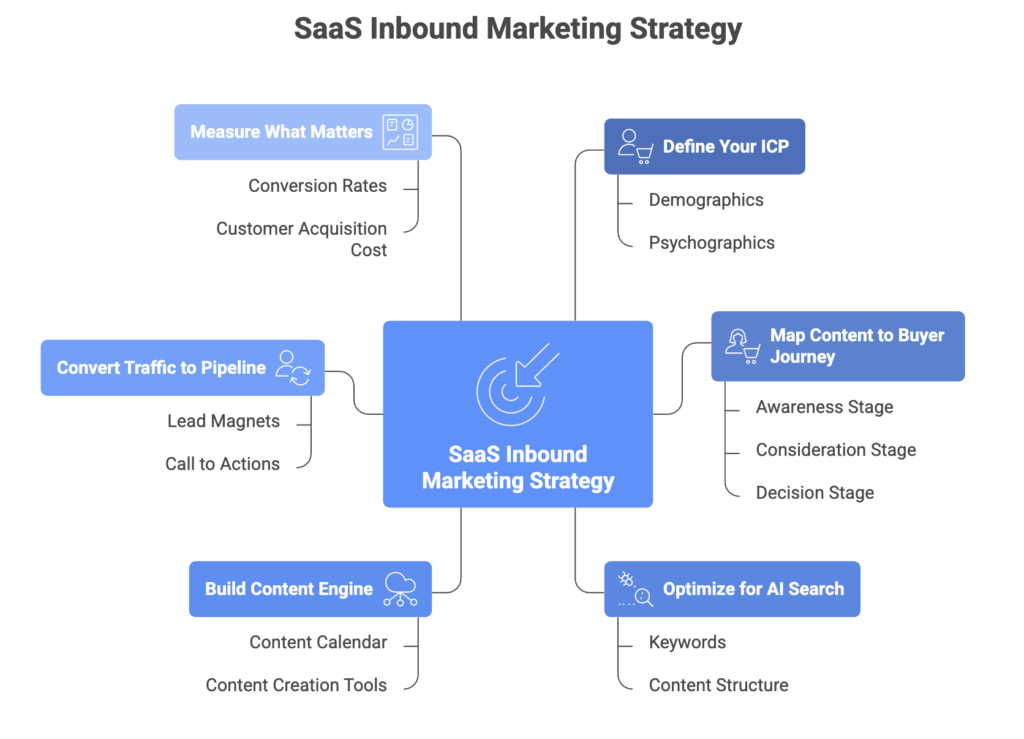
Step 1: Define Your ICP (And Actually Mean It)
Before you write a single blog post or set up one automation, you need crystal clarity on your ideal customer profile. Not “B2B companies” or “tech startups.” I’m talking about specifics.
Start with firmographics: company size, revenue range, industry, tech stack. Then layer in psychographics: what keeps your buyer up at night? What metrics do they report to their board? What’s their risk tolerance?
Here’s a tactical approach:
- Interview your best customers. Schedule 20-minute calls with 5-10 customers who had fast implementations and low churn. Ask what problem they were trying to solve when they found you, what alternatives they considered, and what tipped the scales in your favor.
- Analyze your data. Pull reports on which customer segments have the lowest CAC and highest LTV. Look for patterns in company size, industry, or use case. If your enterprise customers churn faster than mid-market, your ICP probably skews smaller than you think.
- Create negative personas. Know who not to target. If startups with under 10 employees always churn within six months, they’re not your ICP no matter how easy they are to acquire.
Once you’ve nailed this down, every piece of content you create should speak directly to this person’s world.
Step 2: Map Content to the Actual Buyer Journey
Most SaaS companies create content in three buckets: top of funnel (awareness), middle of funnel (consideration), and bottom of funnel (decision). That’s fine as a framework, but it’s too generic to drive results.
Your buyers don’t move linearly from “problem unaware” to “ready to buy.” They jump around. They research intensively for two weeks, then go dark for a month. They read your competitor’s case study, then come back to your blog.
Build a content strategy around real intent
Map content to jobs-to-be-done instead of funnel stages.
When someone is in “problem exploration” mode, they need content that validates their pain point and introduces potential solutions. Think: “Why your customer support tickets are increasing (and what to do about it)” or “The hidden cost of manual data entry in B2B sales.”
When they’re in “solution comparison” mode, they need content that positions your approach. Think: “Point solutions vs. platform plays: What works for scaling SaaS companies” or “Build vs. buy: When it makes sense to develop in-house.”
When they’re in “vendor evaluation” mode, they need proof. Think case studies, ROI calculators, product comparison pages, and demo videos that show real workflows.
“What content actually shortens the sales cycle?”
The answer: content that directly addresses the specific question your prospect has right now, not content that tries to move them artificially through a funnel.
Step 3: Optimize for AI Search (Without Abandoning SEO)
Here’s where SaaS inbound marketing is evolving fast. Your prospects aren’t just Googling anymore, they’re asking ChatGPT, Claude, and Perplexity for recommendations. These AI platforms don’t crawl and rank like Google; they synthesize and cite.
This shift toward generative engine optimization (GEO—basically SEO for LLMs) means you need content that AI can understand, trust, and reference.
- Make your expertise obvious. LLMs favor authoritative sources. Include author bios with credentials, cite original research, and link to reputable sources. If you’re making claims about industry benchmarks or best practices, back them up with data.
- Structure for scannability. AI models parse structured content more effectively. Use clear headings, short paragraphs, and descriptive subheads. When you make a list of features or benefits, use actual lists, not buried in prose.
- Answer questions directly. LLMs are trained to find direct answers to questions. If someone asks “What’s a good CAC for a B2B SaaS company?”, and your article includes a section with that exact question as a heading followed by a clear answer, you’re more likely to get cited.
- Focus on depth, not fluff. Thin content doesn’t get recommended. A 500-word listicle might rank on Google for a low-competition keyword, but it won’t get synthesized into an AI response. Go deep. Provide frameworks, examples, and nuance.
This doesn’t mean abandon SEO. You still need keyword optimization, technical SEO hygiene, and backlinks. But layer in GEO thinking: create content that’s so clear, authoritative, and helpful that an AI would confidently cite it.
Step 4: Build a Content Engine That Scales
Most SaaS marketing teams can’t keep up with content demand. You need blog posts, case studies, comparison pages, email sequences, social posts, and video scripts, all while maintaining quality and voice consistency.
The solution isn’t just throwing budget at freelancers. It’s building a repeatable system.
Start with pillar content. Identify 5-10 core topics that align with your ICP’s biggest pain points and your product’s value props. Create comprehensive guides (2,000+ words) that become your definitive resource on each topic. These are your pillars.
Break pillars into clusters. Each pillar should spawn 8-12 related subtopics. If your pillar is “Customer retention strategies for SaaS,” your cluster content might include “How to calculate net revenue retention,” “Churn analysis frameworks,” “When to implement a customer success team,” and “Pricing strategies that reduce churn.”
This cluster model helps with both traditional SEO (you build topic authority) and GEO (you comprehensively cover a subject, making you a go-to source).
Use AI agents strategically. Tools like Claude, ChatGPT, and Jasper can accelerate first drafts, research competitive angles, and repurpose content across formats. But don’t publish raw AI output. Use AI to speed up research and drafting, then have humans add unique insights, examples from your customer base, and brand voice.
Maintain a content calendar that’s agile, not rigid. Plan themes quarterly, but leave 30% of your calendar flexible for real-time opportunities, industry news, competitor moves, customer questions that keep coming up.
Step 5: Convert Traffic Into Pipeline
Traffic is vanity. Pipeline is sanity. Revenue is reality.
Your inbound strategy only works if it generates qualified leads that sales can close. Here’s how to connect the dots:
- Gate the right content. Not everything should be behind a form. Top-of-funnel educational content should be ungated to maximize reach and SEO value. Gate bottom-of-funnel assets like ROI calculators, detailed implementation guides, or industry-specific playbooks.
- Use progressive profiling. Don’t ask for 12 fields on a first form fill. Start with email and company. On subsequent conversions, ask for role, company size, and tech stack. Build your data over time instead of creating form friction that kills conversion rates.
- Set up lead scoring that reflects actual buying behavior. A VP reading your pricing page five times in a week scores higher than an intern downloading an ebook. Someone who visits from a target account company scores higher than someone from outside your ICP. Tune your scoring based on what actually correlates with closed deals.
- Create segment-specific nurture tracks. A startup founder needs different touchpoints than an enterprise IT director. Build email sequences that speak to different personas, pain points, and use cases. Reference the content they’ve consumed and the problems they’ve signaled interest in.
Step 6: Measure What Matters (Not Just Vanity Metrics)
Page views and social shares feel good, but they don’t pay the bills. Track metrics that connect to revenue:
- Marketing Qualified Leads (MQLs) by source. Which content pieces or channels are driving leads that sales actually wants to talk to? Double down there.
- Content influence on pipeline. Use multi-touch attribution to see which content assets are present in the buyer journey of deals that close. If 70% of your closed deals engaged with a specific case study, that’s a signal to create more like it.
- CAC by channel. Inbound is supposed to be more efficient than outbound, but not all inbound is created equal. Calculate the fully loaded cost (content production, tools, paid promotion) divided by customers acquired through each channel.
- Time to close by content engagement. Do prospects who read 5+ blog posts before requesting a demo close faster or slower than those who go straight to sales? This tells you whether your content is educating and accelerating deals or just attracting browsers.
The Agile Advantage: Move Faster Than Your Competitors
SaaS markets move fast. Customer expectations shift, competitors launch new features, and search algorithms evolve constantly. Your inbound marketing can’t be a “set it and forget it” strategy built on an annual plan.
The companies winning right now treat marketing like product development: agile, iterative, and data-driven.
Run two-week sprints. Launch experiments. Test new content formats, channels, and messaging. Measure obsessively. Kill what doesn’t work and scale what does.
This is where blending human expertise with AI agents creates leverage. Humans set strategy, identify opportunities, and add the insights that only come from actually understanding your customers. AI speeds up execution, drafting content, analyzing data, personalizing at scale.
The agencies that move at a pace most can’t match aren’t just working harder. They’re working smarter with better systems.
Frequently Asked Questions
How long does it take to see results from SaaS inbound marketing?
Expect 3-6 months to start seeing meaningful traffic and lead generation, and 6-12 months for inbound to become a major pipeline driver. Unlike paid channels that deliver immediate results, inbound compounds over time. The content you publish today continues driving traffic and conversions for years. Focus on building momentum through consistent execution rather than expecting overnight wins.
What’s a realistic budget for SaaS inbound marketing?
Plan to invest 5-15% of revenue into marketing, with 40-60% of that allocated to inbound efforts (content, SEO, marketing automation tools). Early-stage companies might operate leaner with one growth marketer and freelance support, while growth-stage companies often need a team of 3-5 plus agency partnerships. The key metric is CAC:LTV ratio—as long as your customer lifetime value is 3x your acquisition cost or higher, you have room to invest more.
Should we prioritize Google SEO or AI-search optimization?
Do both, but weight your efforts based on where your buyers actually search. Most B2B buyers still start on Google, so traditional SEO remains critical. But increasingly, they’re also using ChatGPT and Perplexity for research and recommendations. The good news: many GEO best practices (clear structure, authoritative content, direct answers) also improve your Google performance. Start with solid SEO fundamentals, then layer in GEO tactics.
How do we create enough content without sacrificing quality?
Build a system that combines strategic planning with execution leverage. Focus your best writers on pillar content and thought leadership that only your team can create (customer insights, proprietary frameworks, unique POV). Use AI tools to accelerate research, first drafts, and repurposing. Hire specialists for specific content types (a video editor, a designer) rather than generalists trying to do everything. Most importantly, publish less but better—one exceptional guide beats five mediocre blog posts.
What’s the difference between inbound marketing and content marketing?
Content marketing is a subset of inbound marketing. Inbound encompasses the full strategy: SEO, content, social media, email nurturing, conversion optimization, and lead management. Content marketing specifically refers to creating and distributing valuable content to attract and engage your audience. You can do content marketing without a full inbound strategy (just blogging with no lead capture or nurturing), but effective inbound marketing always includes content as a core component.