Entity SEO isn’t about stuffing keywords, it’s about teaching search engines and AI models what your business actually is, how it relates to other concepts, and why it matters.
The goal of SEO is no longer to be “Result #1”, it is to be the underlying data source for the answer. When ChatGPT, Perplexity, or Gemini synthesize a recommendation, they aren’t scanning for keywords; they are mapping verified relationships between problems and providers. If you haven’t explicitly defined your business as a distinct entity, you have effectively opted out of the AI-driven buyer journey before it even begins.
For SaaS startups, this is the ultimate hedge against rising acquisition costs. Entity SEO is the process of teaching these models exactly what your product is, who it serves, and why it is the authoritative solution in its category. Get this right, and you stop being an entry in a list of links and start becoming the “default answer” the machines provide. Miss it, and you remain invisible to the very systems your customers are now using to make buying decisions.
Table of Contents
What Is Entity SEO, Really?
SEO optimizes for strings, literal keyword phrases people type. Entity SEO optimizes for things, the actual people, places, products, and concepts behind those searches.
Think of it this way: When someone searches “best project management tool for remote teams,” Google doesn’t just match those exact words anymore. It understands that “project management tool” is a software category entity, “remote teams” is a work arrangement entity, and it’s looking for products (entities) that connect to both concepts.
“I’ve noticed Google now pulls up brands I’ve never heard of in featured snippets, even though bigger competitors have the exact keyword. How?”
The answer: Those lesser-known brands have stronger entity signals. Google’s Knowledge Graph recognizes them as legitimate entities in that space, with clear relationships to relevant concepts.
Why Entity SEO Matters More Than Ever
Large language models powering ChatGPT, Gemini, and Perplexity don’t crawl your website daily. They’re trained on snapshots of the web, with knowledge graphs informing what entities exist and how they relate.
If your brand isn’t established as an entity, with structured data, consistent mentions across authoritative sources, and clear semantic relationships, AI systems literally don’t know you exist. Your competitor who is an entity? They’re getting cited in AI responses your prospects are reading right now.
The dual benefit: Entity optimization simultaneously improves:
- Traditional Google rankings (Knowledge Graph signals are ranking factors)
- Generative Engine Optimization (GEO), how often AI models surface and cite you
For startups fighting to lower CAC, this is huge. Every organic mention in an AI response is essentially free qualified traffic.
How Google’s Knowledge Graph Actually Works
Google’s Knowledge Graph is a massive database of entities and their relationships. It knows that:
- Shopify is a e-commerce platform
- Shopify enables online stores
- Shopify competes with WooCommerce and BigCommerce
- Shopify was founded by Tobias Lütke
These aren’t keywords, they’re structured facts about real-world entities.
When you search “Shopify,” Google doesn’t just find pages with that word. It queries its Knowledge Graph for the Shopify entity, retrieves related entities (features, competitors, founders), and assembles a complete answer.
Your goal: Get your brand into this graph with strong, accurate relationships.
How to Audit Your Brand’s Entity Status Using Google’s Knowledge Graph API
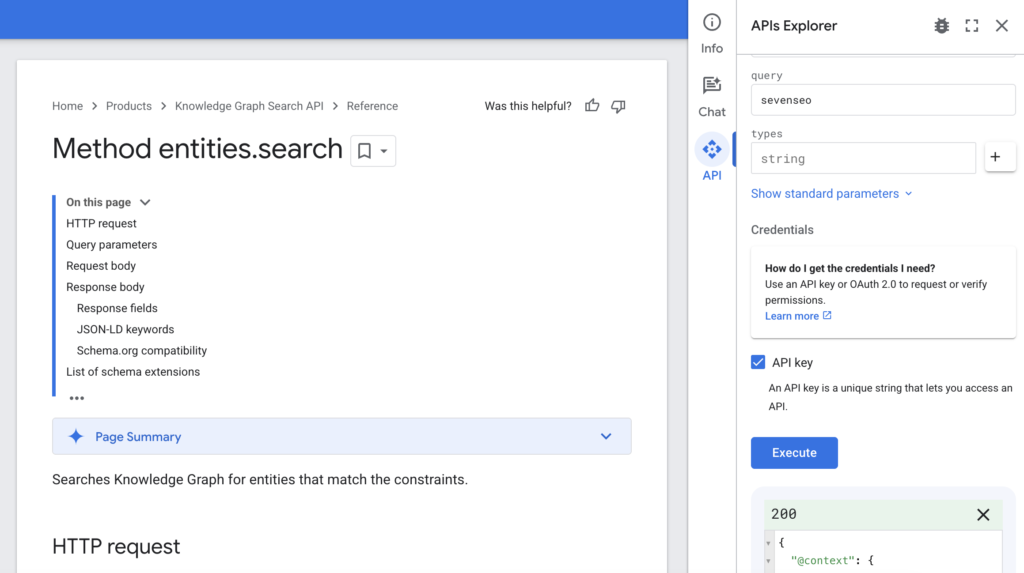
Want to see exactly how Google perceives your brand as an entity? Google’s Knowledge Graph Search API lets you query the same database powering search results—and it’s free for up to 100,000 calls per day.
Here’s how: Visit the Knowledge Graph Search API page, grab an API key, and run a simple query for your brand name. If Google returns results, congratulations, you’re recognized as an entity.
Pay attention to the @type field (Organization, Corporation, LocalBusiness), the description, and what related entities appear. If your query returns empty? You’re not yet in the Knowledge Graph, which means you’re invisible to a major ranking signal and AI training data.
Compare your results to competitors; if they show rich entity data while you don’t, that’s exactly why they’re appearing in AI responses and broader category searches while you’re stuck fighting for branded keywords. This single API check tells you whether your entity optimization efforts are working or if you need to double down on structured data, authoritative citations, and consistent entity signals across the web.
The Wikipedia Framework
Here’s a controversial take that actually works: Model your entity optimization on Wikipedia’s structure.
Why? Because Wikipedia is one of the primary sources Google uses to build its Knowledge Graph. The structure Wikipedia uses to define entities is exactly what Google expects.
Look at any company’s Wikipedia page. You’ll see:
- Clear categorization — “SaaS company,” “founded 2015,” “headquartered in Austin”
- Relationship mapping — Founders, investors, subsidiaries, competitors
- Supporting evidence — Citations to press coverage, financial filings, official sources
- Consistent naming — One canonical name used throughout
You don’t need an actual Wikipedia page (though it helps). You need to structure your entity signals the same way across your digital footprint.
Action step: Draft a hypothetical Wikipedia-style page for your company. Include founding details, leadership, product categories, notable customers, funding rounds, and competitive positioning. Now audit whether this information appears consistently across your website, press releases, Crunchbase, LinkedIn, and industry directories.
Let’s build a SaaS SEO plan that actually drives growth!
Five Entity SEO Optimization Tactics That Actually Move the Needle
1. Implement Schema Markup Like Your CAC Depends on It (Because It Does)
Schema.org markup is structured data that explicitly tells search engines what entities exist on your pages and how they relate.
For a SaaS startup, priority schemas include:
- Organization (your company entity)
- SoftwareApplication (your product entities)
- Product/Offer (your pricing/plans)
- Person (founders, executives)
- Article/BlogPosting (content entities)
The mistake most startups make: Adding schema to their homepage and stopping. Entity SEO requires schema across your entire site, creating a web of entity relationships.
Pro tip: Use Google’s Rich Results Test to validate your markup, then check Google Search Console to see which entities Google successfully extracted.
2. Build Entity Relationships Through Strategic Content
Every piece of content should reinforce what your brand is and how it relates to industry entities.
Let’s say you’re a startup building AI-powered inventory management software. Your content should systematically connect your brand to entities like:
- “Inventory management software” (category)
- “Artificial intelligence” (technology)
- “Supply chain optimization” (use case)
- “E-commerce operations” (industry)
This doesn’t mean keyword stuffing. It means creating content that naturally discusses these relationships: “How [YourBrand]’s AI algorithms help e-commerce companies optimize inventory turnover rates.”
“Why do some companies dominate ‘best [category]’ lists even with smaller marketing budgets?”
Entity strength. When your brand has clear, well-established relationships to category entities, you appear in more contexts without needing backlinks to every individual page.
3. Earn Structured Citations, Not Just Backlinks
Traditional SEO chases backlinks. Entity SEO prioritizes structured mentions on authoritative entity sources:
- Crunchbase (complete profile with accurate funding, team, category data)
- G2, Capterra, Software Advice (product category presence)
- LinkedIn (company page with matching details)
- Industry-specific directories
- Press coverage that mentions your brand in context with category keywords
Each structured mention reinforces your entity. Google sees consistent signals across multiple authoritative sources and gains confidence you’re a real, significant entity in your space.
The CAC impact: Strong entity presence means you show up for broader category searches, not just branded terms. That’s top-of-funnel traffic you don’t pay for.
4. Create and Claim Your Knowledge Panel
A Google Knowledge Panel is the ultimate entity signal, visual proof Google recognizes you as an entity worth highlighting.
Not every startup qualifies initially, but you can accelerate the process:
Get listed in Wikidata (Wikipedia’s structured data counterpart), it’s easier than getting a full Wikipedia page and Google pulls from it heavily.
Maintain a Google Business Profile with complete, accurate information.
Ensure your brand appears in relevant “best of” lists, comparison articles, and industry roundups on authoritative sites.
Use consistent NAP (Name, Address, Phone) across all online mentions.
Once your panel appears, claim it through Google Search Console to suggest edits and monitor how Google represents your entity.
5. Optimize for Entity-Based Voice and AI Queries
When someone asks ChatGPT “What are the best inventory management tools with AI capabilities?” the LLM constructs its answer from entities it knows and relationships in its training data.
To maximize SEO and GEO visibility, create content that:
- Explicitly states entity relationships: “YourBrand is an AI-powered inventory management platform designed for mid-market e-commerce companies.”
- Uses natural language Q&A formats: AI models are trained on conversational text, not SEO-optimized keyword salad.
- Appears on sites AI models trust: Industry publications, major SaaS directories, reputable comparison platforms.
- Includes founder/expert entities: AI models cite individual experts, not just companies. Make your founders quotable authorities.
Measuring Entity SEO Success
Track these metrics to gauge entity optimization impact:
- Brand search volume trends — As entity strength grows, more people search your brand after encountering it in AI responses and broader category contexts.
- Impression share for category terms — Monitor Google Search Console for non-branded keywords where you’re appearing. Entity strength expands this.
- Knowledge panel appearance — The clearest signal you’ve achieved entity status.
- Structured data validation — Search Console shows which entities Google successfully extracted from your markup.
- AI citation tracking — Manually test queries in ChatGPT, Perplexity, and Gemini. Track whether and how they mention your brand.
For startups, the ultimate metric is CAC. As organic visibility through entity optimization expands, your blended CAC should trend down, you’re paying for fewer clicks while attracting more qualified traffic.
The Entity SEO Mindset Shift
Here’s what separates companies that win with entity SEO from those that waste time:
Stop thinking in keywords. Start thinking in concepts and relationships.
Stop optimizing individual pages in isolation. Start building entity networks across your entire digital presence.
Stop chasing Google alone. Start optimizing for knowledge graphs that power both traditional search and AI systems.
This isn’t a one-time project. Entity building is ongoing—every new piece of content, every press mention, every directory listing either strengthens your entity or introduces inconsistency that confuses search systems.
For growth-stage startups, entity SEO is the rare strategy that delivers compounding returns. Early investment creates entity signals that continue driving organic visibility as you scale, systematically lowering CAC while competitors keep outbidding each other for the same paid keywords.
The brands winning in AI-powered search five years from now? They’re building entity authority today.
FAQ: Entity SEO for Startups
Do I need a Wikipedia page to benefit from entity SEO?
No. While a Wikipedia page is valuable, you can build entity signals through schema markup, Wikidata entries, consistent profiles across authoritative platforms (Crunchbase, G2, LinkedIn), and structured mentions in press coverage. Focus on the entity framework Wikipedia represents, not necessarily the page itself.
How long does it take to see results from entity optimization?
Entity building is cumulative. You might see Knowledge Graph recognition in 3-6 months with aggressive optimization, but meaningful ranking and AI citation improvements typically take 6-12 months. The advantage: Unlike paid channels, entity authority compounds—your early work keeps delivering value indefinitely.
What’s the difference between entity SEO and topic clusters?
Topic clusters organize content around themes for internal linking. Entity SEO structures information so search engines understand what real-world things your content discusses and how they relate. They’re complementary: Build topic clusters, then add entity markup and relationships to help search engines grasp what those topics actually represent.
How does entity SEO impact paid search and CAC?
Indirectly but significantly. Strong entity presence expands your organic footprint for category terms, reducing reliance on paid clicks. Additionally, when prospects encounter your brand organically through AI citations or Knowledge Graph features before clicking paid ads, they convert at higher rates—same ad spend, better ROAS, lower effective CAC.